Monday, January 22, 2018

CODGER CONFRONTS DNA METHYLATION


Linda in Thebes

Thank God I’ve found it!  There is an outfit called Two Minute Medicine that boils things down to such short-but-pithy, fact-loaded dimensions that even my fast-depleting store of energy can deal with them.  The article below tosses out some important facts that you all should  consider,  First, some background:
                Methylation:  An epigenetic process whereby a methyl group (CH3) is attached to the DNA molecule.  The effect of methylation usually is to prevent the proper functioning of a gene.
                Promoter:  A segment of DNA which tells the mechanism that translate the DNA sequence constituting a gene into RNA where and when to start.
                Familial cancer:  A cancer that “runs” in a family, with no known inheritable mutated DNA source.  (A purist might cringe at that definition.)

So what they have found is that women with unmutated BRCA1 genes may still be abnormally susceptible to OVCA IF the promoter region of their BRCA gene is methylated.  Sounds reasonable, right?  Furthermore, they have found that the condition of methylated BRCA promoters can be inherited.   Voila!  Familial ovarian cancer.

It seems to me that this discovery adds even more to the case for universal screening of female infants, as well as gives us one more thing to test for.

Read this:


Thursday, January 18, 2018

BLOGGER RETURNS FROM THE DEAD


Linda in Cairo

It has been 38 days since I last added something new to this blog.  Part of that extended hiatus is owing to  ten days in Alaska, first admiring my beautiful granddaughter receiving her RN certification, and then observing Christmas with my extended Cordova, Alaska, family, now swollen to a “go forth, be fruitful, and multiply” level of nine, if you include boyfriends.  However, upon returning to sunny Bellingham I have been engaged in a struggle with some kind of crud – not flu, but close.  For most of that time I have felt like the man described in a famous Yukon poem: “When into the din and the glare, there stumbled a miner fresh from the creeks, dog dirty but loaded for bear (that last doesn’t apply).  He looked like a man with a foot in the grave, with scarcely the strength of a louse….”*

Well, I am up to at least two-louse strength, so I am going to attempt a few cancer blogs, before I travel to Borrego Springs for the balance of the winter – probably next week.  However, at 2-louse strength about all I am up for is to direct you to a couple of important web sites:
<<<<<<<<<<<<<<<<<<<<<<<<<<<<<<<<<<<<<<<<<<<<<<<<<<<<<<<<<<<<<<<<<<<<<<<<<<< 

It has long been known that mutations of BRCA 1, or BRCA2, make women far more susceptible to breast and ovarian cancer.  The prevailing policy, however, has been not to offer testing to the general population, on the grounds that it would not be “cost effective”  (How I hate that term where cancer is concerned!)  Well, an authoritative study in the UK, using “complex mathematical models” indicates it is, in fact, demonstratively cost-effective.  Every woman should be offered that test, free of charge (fat chance.)   Hell, my wife died of ovarian cancer and I don’t even know whether she carried the BRCA mutations, or not.  Linda has several close female relatives, so it would be nice to know!
>>>>>>>>>>>>>>>>>>>>>>>>>>>>>>>>>>>>>>>>>>>>>>>>>>>>>>>>>>>>>>>>>>>>>>>>>>>>>>>>>> 

Another new wrinkle in OVCA therapy.  If this had been available nine tears ago I might have had Linda for one more year.


 *Name the poem and the author

Sunday, December 10, 2017

CAR T and OVCA


Caspar Wistar, M.D.
He was a buddy of Ben Franklin

This is very good news, I believe.  My printer seems to agree: when I attempted to print the article (below) it (my printer) stopped working half way through the first page, emitted a terrible scream (of joy?) – and quit working.  I take that to be a good omen.

You remember CAR T, right?  If not, read


for a refresher course.  In brief, CAR T refers to an immunotheraputic process wherein T cells are targeted at specific cancer cells, then venture forth through the body to find them, and kill them.  So far CAR T has only been used on blood cancers, but now an outfit called ITUS Corporation (of San Jose, California) is preparing to unleash CAR T technology on solid tumors – beginning with our favorite target – ovarian cancer.

From Bio 1a in high school you remember that cells have various proteins attached to their external membrane.  These proteins have specific functions.  For instance, they may signal to glucose molecules to come hither, attach, and be eaten (cells need nutrition, after all.)  Or they may say “hey,  - signals from the pancreas – come over, lock on, and deliver your instructions.  That sort of thing.

Well, some smart people have discovered that a particular protein – they call it “follicle stimulating hormone receptor” (FSHR) – exists only on the ovarian cells of adult women.  In principal, these means that one can extract T cells from an OVCA patient, modify them to recognize (and kill) cells with FSHR proteins on their surfaces – and destroy those (cancerous) cells.  Trials are underway.  Clinical applications: maybe two years away.

My family used to have a saying that went something like “There’s many a slip between the cup and the lip”.  That is certainly true, so we must be aware that this discovery – so simple, so promising – may come to nothing.  But I am greatly encouraged.

So what does Caspar Wistar have to do with any of this?  I will tell you.

Dr. Caspar Wistar was a physician in Philadelphia and a contemporary of Benjamin Franklin.  He was so important that various academic units of the University of Pennsylvania have born his name.  The latest incarnation is the Wistar Institute, which is a biomedical research facility.  The CAR T technology as applied to OVCA was developed in the Wistar labs, using funds provided by you and me  through the NIH.  Wistar Institute does biology, not bio-business, so  presumably they sold  the right of development to ITUS.  However, ITUS has sub-let the actual work to something called the Moffitt Cancer Center.  No wonder the development efforts will cost upwards of $ I million.

I tell you all this to help you understand how the Pharma universe operates.  I withhold judgement.


Linda, in the mood for Christmas

Tuesday, December 5, 2017

FRANKENSTUFF


Dr.Francis Collins, Director of the NIH
Former lead guitar for the Rolling Stones
(No, I made that part up)

Dr. Collins is one of my current heroes.
Along with Russell Wilson

Now this sort of scares me.  People at Scripps have created what can only be called “frankenproteins”.  They are excited.  So was Dr. Frankenstein when he zapped his monster into life.  We all know how that turned out.

Not to insult your intelligence, but I want you to recall that our entire heredity is “written” in a code consisting of only four letters:  A, T, C, and G. The “book” containing these letters is the DNA double helix.  Baring errors, in the DNA molecule A always bonds with T, and C with G.  It is the sequence of these A-T and C-G parings that tells a creature to develop into, say, a tadpole, rather than, say,  Donald Trump.

A, T, C, and G are known as nucleotides.   They “code” for the proteins, upon which all life depends.

Well, some adventurous folks at Scripps in San Diego have created two new nucleotides, which they call X and Y (pitiful lake of originality).  X pairs with Y, just like A-T and C-G.  Furthermore, they have inserted the X-Y pair into the bacterium E. coli, and then run the resulting (man-made!) genetic material through the normal DNA-to-protein assembly process.  And - Voila! – A new, totally unnatural, man-made protein walks (slithers, actually) the face of the earth!

The Scripps folk are jubilant, and forecast all sorts of uses for these frankenproteins.  Dr. Collins, Director of NIH and the author of many learned publications, enthusiastically agrees.  So maybe I should be happy with this development.  After all, it is a promising tool, right?  And the Scripps people assure us that it can’t get out of hand:  they have to feed it just to keep it alive.  Yeah, sure.  The original Frankenstein creation learned to go get its own food.  We don’t want to see globs of frankenprotein slithering around the lab, eating the lab rats!

Seriously, this stuff disturbs me a bit.  I think we must proceed very carefully.

By the way, Dr Francis Collins not only runs NIH, which has a budget similar in size to, say, the U.S. Navy – he also has time to author a series of highly informative blogs.  You should get on his mailing list.


 Linda at the gourd farm.
She delighted in decorating gourds.


Thursday, November 30, 2017

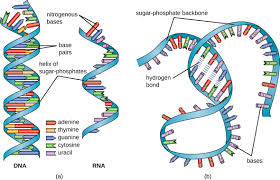
RNA

RNA and DNA
Ain't they pretty?

Ever hear of Thomas Jefferson University?  Well, neither had I, until today.  It turns out to be a mostly professional/grad student sort of place, located in Philadelphia.  One of its subdivisions is the Sidney Kimmel Cancer Center, of which I definitely have heard, multiple times.  Out of SKCC emanates an interesting report on a factor contributing to metastasis of ovarian cancer.  It involves something symbolized by lncRNA.  That’s l as in “long”, not “one”.  Those symbols always get twisted up in my brain.

So, you know a lot about RNA, right.  It is a nucleic acid molecule, not much different from DNA.  Most people know RNA as a messenger molecule, functioning to carry information from the genes imbedded in DNA to a ribosome, where it is used to manufacture the protein molecules which keep us all purring along.  You might call such RNAs as “coding RNSs”, because they carry the “code” for the protein’s structure.  Thus, lncRNA stands for “long non-coding RNA”.    Long non-coding RNA is a product off what once was referred to as “junk DNA”, because the product had no obvious use.  Now we know that these ncRNA molecules perform an essential service; they regulate which genes are “expressed”.  Probably some ncRNA is responsible for the fact that you don’t grow toenails in your eyeballs.

Geez!  This was supposed to be a simple little report, but it has gotten well out of hand.  The gist of the matter is that these folks at SKCC have shown that specific lncRNAs are strongly associated with metastasis of OVCA .  They did this using “bioinformatics”, which involves feeding a large mass of data to a computer algorithm, and seeing what comes out.  Read about it, below.  There is a possibility that new therapies could be directed against these particular lncRNAs

In previous blogs I have said that, if had it to do over again, I would go into molecular biology.  However, as I have the small-muscle dexterity of a walrus but am not entirely hopeless at mathematics, I think bioinformatics would be the better choice.


 Linda and Scottish friend
Isle of Skye  


Wednesday, November 29, 2017

MORE ON PARP


Double stranded break in DNA, on the right
PARP will fix it, unless we intervene

Here is an update on PARP inhibitors as applied to ovarian cancer.  I have been guilty of runaway enthusiasm for immunotherapy; until immunotherapy proves to be the weapon that eventually eliminates ovarian cancer (as I believe), PARP inhibitor drugs will serve the vital purpose of extending lives.  This article speaks of PFS (progression-free survival) rather than mortality, but surely the two must roughly  correlate.  The article describes several clinical trials, which found that the PARP drugs in general lengthened PFS by one to two years.  In the past I have been scornful of treatments that were not outright cures,  but now I realize I was wrong.  What would I not have given or done to give Linda an extra 18 months  of life?

This article is tough sledding in places, so you should glance at the following glossary before you try:

PARP (Poly ADP ribose polymerase) is a family of proteins that serve to repair double-stranded DNA breaks.  OVCA cancer cells have many such breaks, so if you can screw up the PARP you can inhibit growth of the cancer.

Germline BRCA mutations refers to inherited DNA defects.

Platinum-based, platinum-sensitive:  Most standard OVCA chemo drugs are based on platinum, which most OVCA cancer cells don’t like at all.  Unfortunately, some such cells almost inevitably survive – leading to recurrence.

AE:  Adverse effects, meaning bad side effects

Neutropenia means a deficiency of certain essential white blood cells

Thrombocytopenia seems to be a difficult way to say platlet-deficiency

BRCA “wild type” means unmutated BRCA genes.  For some reason geneticists refer to an undamaged chunk of DNA as “wild”.  They must lead an awfully placid life.

Okay, now give this a try.


And for trying, here is an award:


Linda and my Mom, probably 1982


Tuesday, November 28, 2017

THE ONLY GOOD VIRUS IS A DEAD VIRUS

An adenovirus, presumably dead

Viruses are bad, right?  Well, not necessarily.  Dead or denatured virus is used as a messenger boy, to deliver modified genes to the correct place in the DNA molecule.  How?  Believe me, if I knew I would show off by explaining it to you, at great length.  But I don’t know, so you are spared some – perhaps boring – biology. Give thanks.

Anyway, they do use virus to deliver the goodies, and therein lies a problem you probably didn’t anticipate:  there is an acute shortage of properly prepared virus.  There are entire biotech firms wholly devoted to the preparation of types of properly modified viruses – and they have years of backlog.  It turns out that you don’t fix up medicinal virus in your garage.  It costs hundreds of millions of dollars to get into the game.  That is partially why some new drugs cost so much.  Partially.

All this is explained in the NYTimes article below.  Take a few minutes and read it.


Linda and Ella