Wednesday, March 13, 2019

TWO USEFUL ARTICLES


Linda and Viv Hailwood, on a long-ago Howgill hike

The Economist must be the prince of news magazines.  Yes, at times it does suffer from an overdose of British humour and a wanton waste of vowels – note the superfluous  second  “u” in humour – but it covers what is important in the world with clarity, thoroughness,  and, for the most part, a lack of obvious bias ( they do draw the line at the misadventures of our current President, however).  Last week’s edition had two articles that concern medicine that are well worth reading.

The first, 


describes efforts to “repurpose” drugs, already approved for one or more conditions, to other uses.  Often, I suspect, genetics suggest possible unsuspected efficacies.  Repurposing a drug costs a hell of a lot less than developing one de novo,  and requires less paperwork – although still, in my view, too much.  Read the link and see if you agree.


examines Big Pharma – a thing we all love to hate – and their pricing policies.  The central question addressed is, “Why do drugs cost more here than almost anywhere else?”.  The answers given will not satisfy you.  Drug pricing is one of those issues, a growing number, about which all I can say is – “There’s a big problem here, but I don’t know what’n hell to do about it.”  When I was younger I would have known - immediately - and like as not been wrong.

Tuesday, March 12, 2019

GENE THERAPY AND SICKLE-CELL ANEMIA


Alaska cousins
Each 12.5% me

Thanks to my friend Phil Montague for tipping me off to this valuable info-bit.

You probably know what sickle- cell anemia is: an excruciatingly painful disease caused by misshapen red blood cells.  They – the blood cells – get this way because of a genetic mistake involving just one letter of the DNA alphabet.  It turns out that NIH has sponsored research leading to a cure – an actual cure – for sickle-cell anemia.  The process is described in a segment of last Sunday’s 60 Minutes TV show (3/10/19), largely through an interview with Dr. Francis Collins, Director of NIH (see https://ljb-quiltcutie.blogspot.com/2017/12/frankenstuff.html).  If you have a TV you should hasten to watch this program, especially if you are still shaky on how gene therapy works.  (And aren’t we all?). 

Several times previously I have declared Dr. Saul Rivkin to be my hero.  Saul lost his wife to OVCA at an early age; he responded by establishing the Marsha Rivkin Center for Ovarian Cancer Research, while raising at least $15 million for its support.  But to Saul I now add Dr. Collins, who headed the official effort to decode DNA, and now serves in a capacity to greatly influence where medical research funds go.  Dr. Collins is a brilliant scientist, an articulate blogger (see NIH web site) – and he even plays a mean guitar! 


Sunday, March 10, 2019

LOSARTAN: GOOD FOR OVCA?


Linda on a birding expedition

I take Losartan for high blood pressure, and it is darned likely that you do, too.  Losartan is an effective drug – even though there was a recent flurry of panic over whether or not it contained trace amounts of some carcinogen or another.  Well, there has arisen some medical evidence that taking Losartan correlates with, and may be responsible for, increased longevity in OVCA patients.  Rodents are dying even now, to test this hypothesis.  This link will fill in some of the details:


We are making progress.

Friday, March 8, 2019

CLINICAL TRIALS: GUIDELINES


In our new house:  1984
I have urged you repeatedly, in my 656 (!) blogs, to be aware of and receptive to the possibility of participating in a cancer clinical trial.  Regrettably, I have not spent many words on other important matters, such as eligibility and feasibility.  For instance: you may be ineligible to participate in a trial if you are too old, too young, or perhaps otherwise too sick.  Also, participating in a trial may not be feasible if it requires you to abandon your husband and twelve kids and move to NY City.  Well, the NCI has finally got around to considering these issues, in this highly useful little essay:


Much of the problem, it seems, lies with well-meaning but poorly informed “clinicians” (e.g., your family doc or your oncologist).  Make sure these guys are up to speed.


Thursday, March 7, 2019

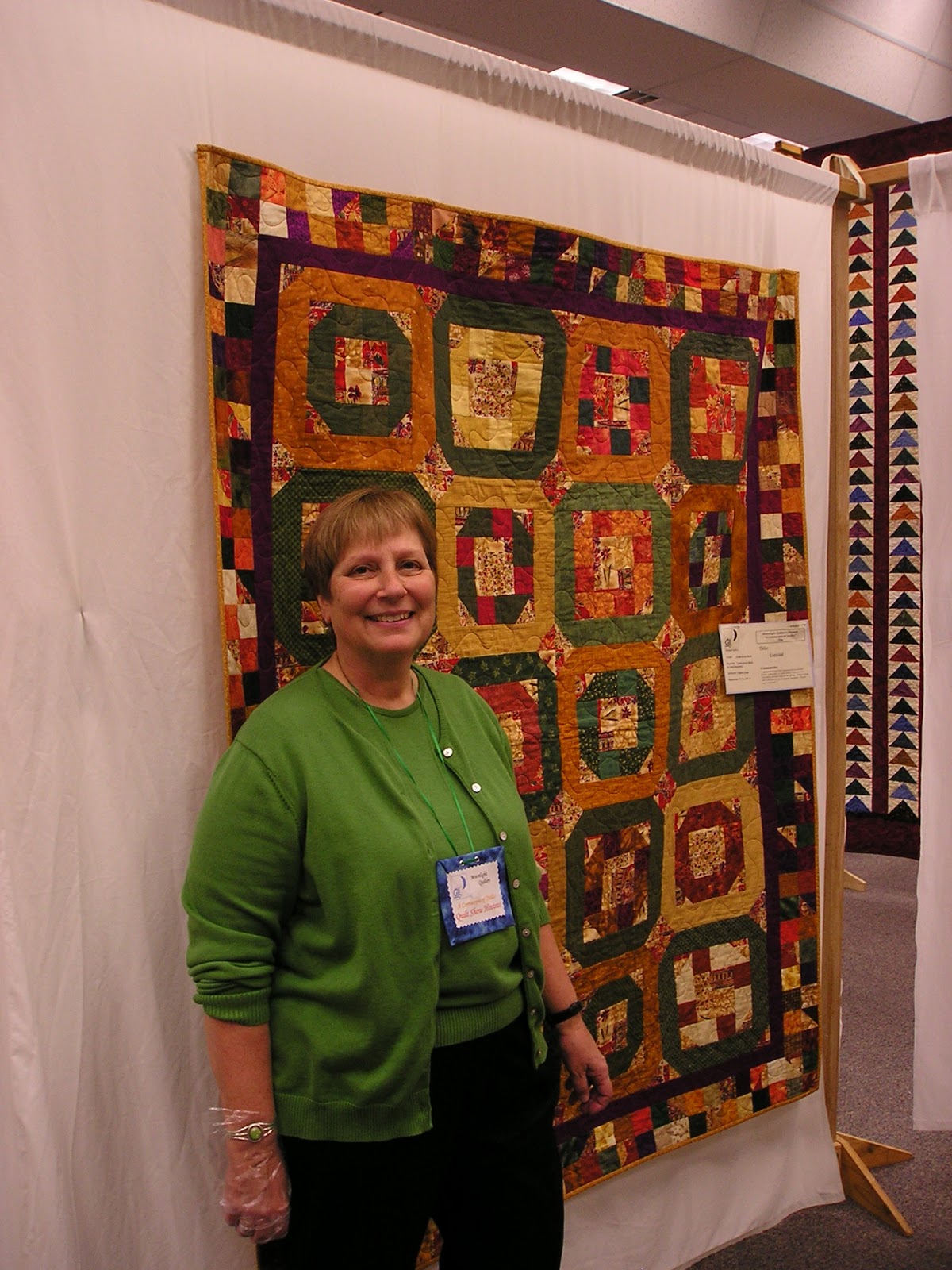
THE LINDA JOYCE BECK QUILTING COMPETITION


Linda and one of her quilts

Ann Bjorseth, Linda’s long-time very good friend (and my once-upon-a-time girlfriend), alerts me to this news article.  It appears that in Canada they have a very straightforward and effective approach to raising money for a good cause:  play some hockey.  Seems that a woman named Sue Deacon, who loved – and played – hockey died a few years ago, of ovarian cancer.  Her friends responded by organizing the Sue Deacon Cup, a hockey tournament.  So far they have raised a half-million, and are supporting several OVCA research projects.  Of course, my hero Dr. Saul Rivkin has raised about $15 million for the same purpose, largely by sponsoring a foot-race – but Saul has been at it for decades.  By 2030 I hope to see the winner of the Sue Deacon Cup go straight to the Winter Olympics – and win.

But Linda wasn’t much of an athlete, so what should I start in her honor?  A quilting competition?  The Linda Joyce Beck Quilting Super Bowl?  Maybe not, but it sounds nice. 


Saturday, March 2, 2019

A CANCER-GENETICS PRIMER


Linda and her Mom, in front of Linda's new mobile home
This was pre-me

This is a Cliff Notes-type summary of cancer genetics.  You know most of this stuff, but a review wouldn't hurt.


HACHIMOJI DNA


Marion &^ Linda, in Borrego days of yore.

I am getting in over my head, that’s for sure.  After many encounters with basic genetics I am pretty comfortable with DNA, RNA, proteins, and how they all work together to construct the glory that is us.  I also can tell you glibly about the essence of DNA:  sugar-phosphate support in the form of a twisted ladder, with “rungs” consisting of four “bases”, a, c, g, and t, with t fitting together with a to form one kind of rung, and c mating with g to yield another.  If an accident occurs and a hooks up with g, for instance, the DNA molecule is distorted and – possibly – there’s all hell to pay.
Well, now scientists at several institutions have manufactured four totally new bases, and moreover succeeded in inserting them in natural DNA, to form to form what the call hachimoji  (Japanese for eight letter) DNA.  It seems that HM DNA can be copied onto messenger RNA and then run through a ribosome to produce – what? – new, synthetic proteins perhaps, provided the amino acids called for already exist.  Scary.  In the meantime HM DNA may earn its keep as a data-storage device.  There also is some mention of new drugs.

So, stay tuned.  No telling what the guys in white coats will come up with next.

Oh, best to say that HM DNA is said not to be a threat to escape the lab and attack your house pets.  Seems it has to be fed constantly, just to stay alive.

Lots of useful links to hachimoji  DNA.  Just trust yourself to Google